Best ATV For Snow Plowing
There is a distinct misery to the sound of a plastic shovel scraping against concrete at 5:00 AM. It’s the sound of back pain. But flip the key on a utility quad, feel the engine thump to life in the frozen air, and suddenly that driveway full of snow doesn’t look like work—it looks like an excuse to ride. Winter doesn’t mean the riding season is over; it just means the work season has started.
For pure reliability, the Honda Foreman 520 is the king of plowing because its geared transmission eliminates the risk of burning a CVT belt. However, if you prioritize ease of use and quick attachment, the Polaris Sportsman 570 with the Glacier Pro system is the user-friendly favorite. You do not need massive horsepower; you need vehicle weight, a low-range gear, and 4WD with a locking differential.
What Actually Matters?
Forget horsepower numbers. They are irrelevant here. You can plow a driveway with a 300cc engine if it’s geared right. I see guys buy 1000cc mud monsters thinking they will dominate the driveway, only to find themselves spinning tires on a dusting of ice. Plowing is a game of static friction and torque, not speed.
Transmission Type (The Belt Factor)
If you spend five minutes on any ATV forum, you’ll see the horror stories. “Smells like burnt rubber.” “Quad won’t move.” This is the curse of the CVT (Continuously Variable Transmission) when used improperly.
Most modern quads use a rubber belt to transfer power. When you push a heavy wall of wet snow, the resistance is massive. If you try to do this in High Gear, the pulley spins, but the belt stays still. Friction builds instantly. Heat spikes. The belt glazes or snaps.
- The Geared Advantage: This is why the Honda Foreman and Rubicon are legendary. They use a driveshaft and a physical gear transmission (either foot-shift or Dual Clutch Transmission – DCT). There is no belt to slip. You put it in first gear, and the wheels turn or the engine stalls. There is no middle ground where you burn up $200 parts.
- The CVT Rule: If you run a Polaris, Can-Am, or CFMOTO, you must have a Low Range Gear. You do all your plowing in Low. Period. This keeps the RPMs up and the belt engaged firmly.
Weight Is Your Friend
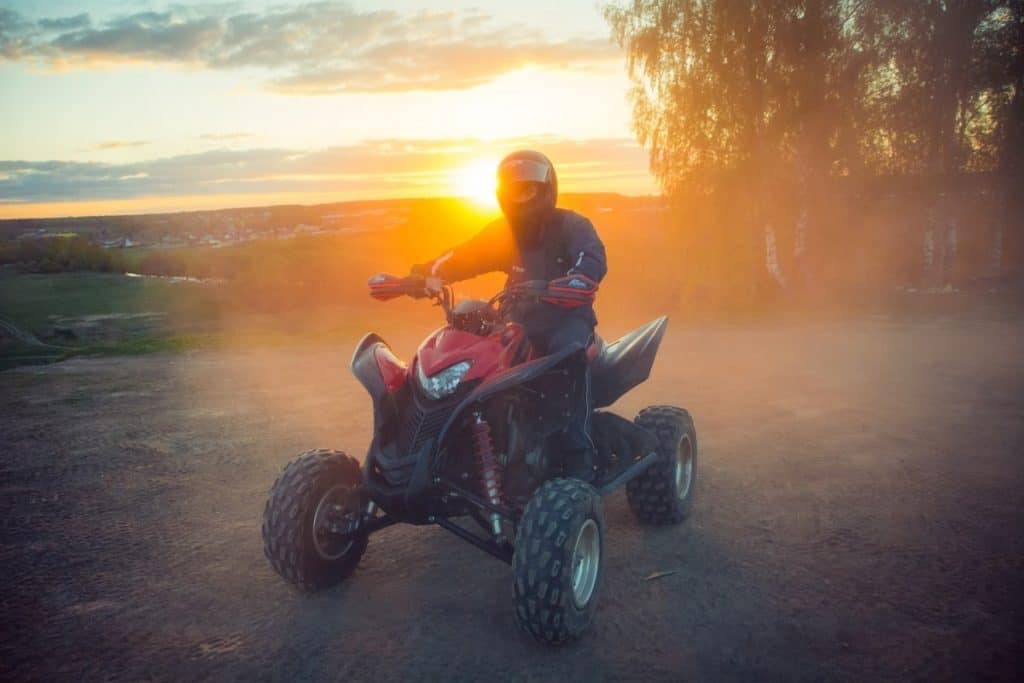
In the summer, I strip weight off my bikes to float over the Florida sand. In the Ohio winter, I do the opposite. A 400lb sport quad like a Raptor creates zero traction on ice. It just spins.
You want a heavy, utility machine. A 700lb machine pushes harder than a 500lb machine because gravity pushes the tires into the pavement. This is why a 450cc-500cc utility quad is the “Goldilocks” zone. It has the frame weight of a big bore but consumes half the fuel.
EFI vs. Carburetors (The Cold Start Reality)
I love old bikes. But I hate carburetors in January.
If you have ever tried to kickstart a carbureted bike when it’s 5 degrees out, you know the struggle. You are messing with the choke, draining the battery, and freezing your fingers before the engine even fires.
For a dedicated plow rig, get Electronic Fuel Injection (EFI). The ECU reads the air temp and adjusts the fuel mixture instantly. You hit the button, it starts. End of story.
Top Picks for 2025/2026
I’ve cleared driveways with everything from a rusted 1990s Moto-4 to a brand new Outlander. Here is how the market stacks up right now.
The Workhorse: Honda Foreman 520
This is the tool you buy if you want to hand it down to your grandkids. It’s tractor-like.
- Why It Wins: The transmission. Whether you get the foot-shift or the DCT, you have direct drive. The rear axle is a solid straight axle, not independent suspension. This means when you weigh down the back with salt bags, the suspension doesn’t squat and change the camber of the tires. It stays planted.
- The Trade-off: It rides rougher on the trails than the competition. It’s a truck, not a sedan.
The Smooth Operator: Yamaha Kodiak 700
Yamaha does something special with their CVT called the Ultramatic. Unlike other brands, their system maintains constant tension on the belt. It has a sprag clutch that allows for natural engine braking.
- Why It Wins: When you let off the throttle on an icy hill, the Kodiak slows down naturally. Other CVTs effectively go into “neutral” and you start coasting, which is terrifying on ice.
- Kodiak vs. Grizzly: Buy the Kodiak for work. It has lower gearing, a lower seat height, and is tuned for low-end grunt. The Grizzly is wider and tuned for trail ripping.
The Suburban Favorite: Polaris Sportsman 570
Polaris understands that most people don’t want to spend an hour bolting a plow bracket to the frame.
- Why It Wins: The Glacier Pro plow system. It is a “click-and-go” setup. You drive up to the plow, it clips onto the integrated mount, and you’re done in 30 seconds.
- The Value: You get more horsepower and features for the money than Honda or Yamaha, but you have to be disciplined about using Low Range to save that belt.
Comparison Table: Specs at a Glance
| Model | Engine / Class | Trans Type | Weight (Curb) | Plow Mounting | Best Feature |
| Honda Foreman 520 | 518cc | Gear / DCT | ~646 lbs | Bolt-on Bracket | Indestructible Trans |
| Yamaha Kodiak 700 | 686cc | Ultramatic CVT | ~660 lbs | Bolt-on Bracket | Sprag Clutch (Engine Braking) |
| Polaris Sportsman 570 | 567cc | PVT (CVT) | ~700 lbs | Integrated | Quick-Attach System |
| Can-Am Outlander 500 | 650cc | CVT | ~750 lbs | Bolt-on | Visco-Lok 4WD |
Front-Mount vs. Center-Mount
The plow blade is just a sheet of steel. The mounting system is what defines your experience.
Center-Mount (The Standard)
The push tubes go all the way back under the ATV and attach to the middle of the frame.
- Pros: Incredible structural stability. You are pushing from the machine’s center of gravity.
- Cons: You lose about 3 inches of ground clearance. If you leave the mount on for summer trail riding, you will hang up on logs and rocks.
Front-Mount (The Modern Choice)
The mount attaches to the front bumper area.
- Pros: High lift. You can lift the blade higher, which is critical for stacking snow (pushing the pile up and over a curb). Easy to take on and off.
- Cons: Puts more stress on the front suspension.
“Snow Fighter” Setup Guide
Buying the quad is Step 1. Setting it up is Step 2. When I moved from Florida to Ohio, I learned these lessons the hard way—usually while freezing my hands off in a blizzard.
Tires & Chains
Stock tires are usually garbage for snow. They are 2-ply “balloon” tires meant for showroom looks.
You have two options:
- Dedicated Snow Tires: Look for a soft compound with massive lugs.
- Tire Chains: If you have hard-packed ice, chains are the only thing that works.
- Robert’s Warning: Do not use V-bar chains if you have an asphalt driveway. They will chew it up and leave scratches everywhere. Chains are for gravel or dirt driveways only.
The “Warm Rider” Checklist
You cannot control the machine if you can’t feel your thumbs.
- Heated Grips: This is not a luxury; it is safety gear. For $50, you can install clamp-on heated grips. Combined with a Thumb Warmer, they keep your dexterity intact.
- Handlebar Gauntlets: These are those ugly neoprene muffs that go over the bars. They block the wind chill completely. With grips and gauntlets, you can plow in thin gloves.
Ballast & Lighting
- Rear Ballast: I keep two 60lb tubes of sand in the garage. When the snow falls, I ratchet strap them to the rear rack. This counteracts the weight of the plow on the front and drives the rear tires into the ground for traction.
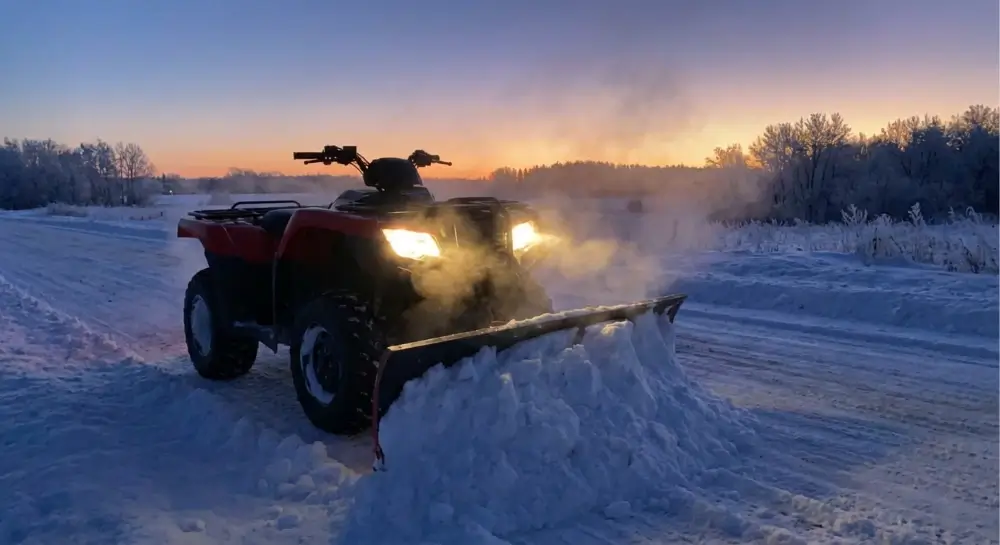
- Auxiliary Lights: Here is a design flaw nobody mentions: When you lift the plow blade, it blocks your headlights. You are suddenly driving into a black void. Mount a cheap LED light bar on the handlebars or the front rack above the plow line.
How to Plow Like a Pro
Plowing is not just ramming speed. If you hit a hidden curb at 15 MPH, you will go over the handlebars. I don’t care how tough you are.
Rule 1: Plow With the Storm
Don’t wait for the storm to end. If the forecast says 12 inches, go out when there are 4 inches. It is infinitely easier to move three layers of 4-inch snow than one layer of heavy, wet, 12-inch sludge.
Rule 2: The “Push Back”
Early in the season, push the snow 3 to 4 feet past the edge of your driveway. You need to build a perimeter. If you stop right at the edge, when the next storm comes, you have nowhere to put the new snow because the banks are frozen solid.
Rule 3: Watch the “Hidden Anvils”
Frozen garden hoses. Raised sprinkler heads. That one cobblestone that sticks up. When the Wear Bar on your plow hits these immovable objects, the plow springs will trip (the blade folds forward), but the shock travels right through the frame to your arms. Keep your thumbs on the outside of the steering wheel or grips if possible to avoid jamming them.
FAQ
How many CCs do I really need to plow?
You can plow effectively with a 400cc machine. Traction and gearing matter far more than displacement. A 450cc ATV in Low Range has enough torque to push a truck. Don’t upsell yourself to a 1000cc machine just for driveway duty unless you also want it for extreme mud riding.
Should I use a winch or a manual lift?
A winch is easier on your arm, but slower. You have to wait for the electric motor to wind up and down. A manual lift lever (on the left side of the bike) is instant—you slam it down, plow, yank it up, reverse. For small driveways, manual is faster. For long driveways, get the winch.
Will plowing ruin my ATV?
Only if you abuse the transmission. If you plow in High Gear on a CVT machine, you will burn the belt. If you constantly slam into snow banks at full speed, you will tweak the frame or A-arms. Treat it like a tractor, not a trophy truck, and it will last for decades.
What is the “Wear Bar”?
It is the strip of steel or plastic bolted to the bottom edge of the plow blade. It is a sacrificial part designed to grind against the concrete so your actual blade doesn’t. Check it every season. If it wears down to the blade metal, flip it over or replace it.
How much battery power (CCA) do I need?
Cold weather kills batteries. A standard lawn mower battery won’t cut it. Look for a battery with at least 300 Cold Cranking Amps (CCA). I also recommend keeping the machine on a battery tender (trickle charger) whenever it’s parked in the garage during winter.