What should I buy Pit Bike or Dirt Bike?
You are standing in the dealership or staring at Marketplace listings, and the math is screaming at you. On one side, you have a brand new, shiny pit bike for $1,500. On the other side, you have a beat-up, ten-year-old full-size dirt bike for $3,500.
The wallet wants the pit bike. The ego wants the big bike. But making this decision based on price tag alone is the fastest way to end up with a machine that collects dust in the corner of your garage. I’ve seen grown men buy pit bikes thinking they would trail ride with their buddies, only to realize five miles into the woods that they brought a skateboard to a monster truck rally.
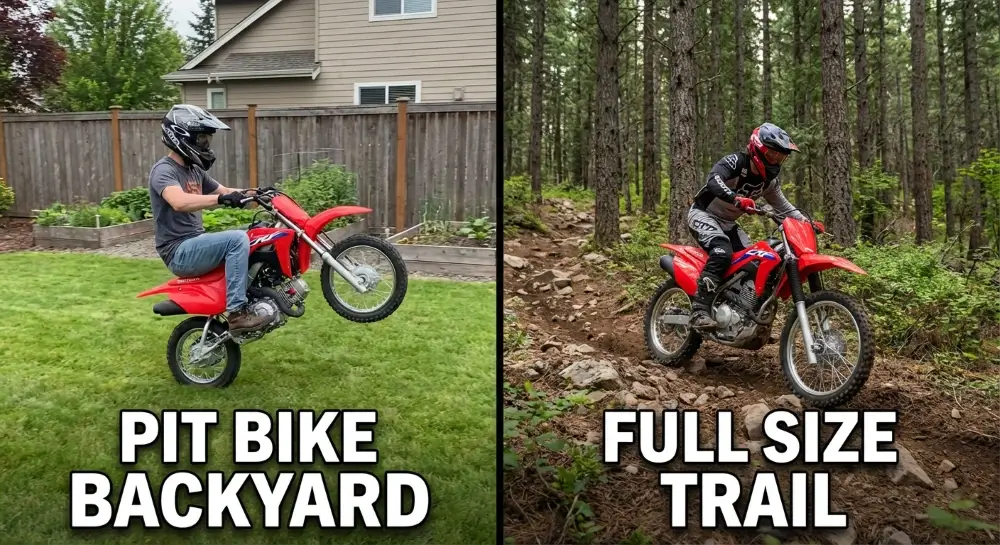
If you want a machine for backyard fun, learning clutch control, or riding on less than an acre of land, buy a pit bike. It is a low-stakes “toy” that prioritizes laughs over capability. If you plan to ride actual trails, keep up with friends in the woods, or ride for more than 30 minutes at a time, you must buy a full-size trail dirt bike. A pit bike simply cannot handle the ruts, rocks, and endurance required for real off-road riding.
The Core Differences: It’s More Than Just Size
To the uninitiated, a pit bike just looks like a shrunken dirt bike. But mechanically, they are built on completely different architectures.
Engine Architecture (Horizontal vs. Vertical)
Look at the engine block.
Pit Bikes
Almost all pit bikes (Kawasaki KLX110, Honda CRF110F, and the Chinese SSR/Apollo clones) use a Horizontal Engine. The cylinder lays flat, pointing toward the front tire. This design is compact and keeps the center of gravity low, but it limits the displacement. You generally top out at 140cc-190cc before the engine gets too long and hits the front fender under compression.
Dirt Bikes
Full-size trail bikes (Honda CRF250F, Yamaha TTR230) use a Vertical Engine. The cylinder stands up. This allows for a longer piston stroke, better cooling airflow around the fins, and much higher oil capacity.
The Frame Geometry Gap
This is where the safety factor comes in.
A full-size bike uses a Full Perimeter Frame or a semi-double cradle where the frame rails wrap around the bottom of the engine. The engine sits inside the frame.
A pit bike usually uses an Open Cradle Frame (or spine frame). The engine hangs off the bottom of the frame by two long bolts. The engine block itself is a stressed member of the chassis.
Why this matters
If you are a 200lb adult and you case a jump on a stock pit bike, the force doesn’t just bend the frame. It can rip the footpeg mounts right out of the aluminum engine case.
The Wheel Size Physics (The Rut Problem)
I have a simple rule for riding in the woods: The Rut Rule.
If the rut is deeper than your axle, you are done.
The 12-Inch vs. 21-Inch Reality
Pit bikes typically run a 14-inch front and a 12-inch rear wheel setup. Full-size bikes run a 21-inch front and an 18-inch rear.
That difference sounds purely academic until you are in the deep clay ruts of Ohio or the whooped-out sand trails of Florida.
- Small Wheels (Pit): A 12-inch wheel falls into holes. It doesn’t roll over them. When you hit a 6-inch root on a pit bike, the wheel stops dead, the suspension bottoms out, and you go over the handlebars. It’s violent.
- Big Wheels (Dirt): A 21-inch front wheel bridges the gap. It floats over the top of the root or the pothole. The gyroscopic effect of the larger, heavier wheels also makes the bike want to stand up and go straight, providing stability that a twitchy pit bike can never match.
I took a tricked-out KLX110 to a hare scramble course once just for laughs. It was funny for the first lap. By the second lap, my wrists were swollen from the jarring impact of every rock, and I got high-centered on a log that a TTR125 would have rolled right over. I walked it back to the truck.
The Pit Bike: Pros, Cons, and The “Adult Mini” Craze
There is a massive subculture of adults riding kid’s bikes. It’s called the “Adult Mini” scene. It is legitimate fun, but it requires specific modifications. You cannot just ride a stock CRF110F as a grown man without breaking it (or yourself).
The Fun Factor (Type 1 Fun)
Riding a pit bike is “Type 1 Fun.” It’s fun right now. It’s low to the ground, so you aren’t afraid of crashing. The speeds are low (30-40 MPH max). It is the perfect tool for a backyard track where you can bang bars with your buddies while the grill is going.
It’s also the best way to learn clutch control. If you whiskey throttle a 110cc bike, you might bruise a shin. If you whiskey throttle a 450, you might end up in the hospital.
Mandatory Mods for Adults
If you buy a pit bike, you must budget for these upgrades immediately.
- Heavy-Duty Cradle: You need to buy an aftermarket steel cradle that bolts to the frame and tucks under the engine. This protects the cases from snapping when you land hard.
- Tall Seat Foam: Stock pit bikes are built for 8-year-olds. The “Rider Triangle” (distance between pegs, seat, and bars) is cramped. A tall seat saves your knees.
- Pro Taper “Mini High” Bars: You need to raise the handlebars so they don’t hit your kneecaps when you turn.
The Chinese Clone Warning
Amazon is flooded with brands like SSR, Apollo, TaoTao, and Coolster.
They look like Hondas. They cost $900.
Robert’s Warning: They are made of “soft metal.” The bolts strip if you look at them wrong. The chains stretch like rubber bands. The carburetors are often jetting nightmares straight out of the crate.
If you buy one, you must Loctite every single bolt before you ride it. Even then, do not take a Chinese pit bike deep into the woods. When (not if) a wheel bearing explodes or a shift lever falls off, you are pushing it home.
The Dirt Bike (Trail Bike): The Real Off-Roader
When we say “Dirt Bike” in this context, we aren’t talking about a $10,000 KTM race bike. We are talking about the air-cooled, bulletproof trail bikes: The Honda CRF-F series, Yamaha TTR, and Kawasaki KLX-R.
Capability and Comfort (Type 2 Fun)
Riding a full-size bike is often “Type 2 Fun.” It’s hard work. It’s physically demanding. But the reward is adventure.
- Suspension Travel: A trail bike gives you 9 to 11 inches of suspension travel. This soaks up the chop. You can ride for 4 hours and still be able to walk the next day.
- Ergonomics: You can stand up. This is critical. In the “attack position,” your legs act as secondary suspension. On a pit bike, you are stuck in a squat, which burns your quads out in minutes.
Reliability for the Long Haul
A Honda CRF250F or Yamaha TTR230 is designed for “severe use.” They hold more oil (usually a quart or more), which keeps the engine cooler during slow, technical riding. A pit bike holds barely nearly no oil (often less than a quart), which breaks down rapidly under the stress of carrying an adult.
2025 Market Snapshot
Here is the breakdown of the most common options you’ll see on the showroom floor or Craigslist.
| Feature | Pit Bike (e.g., Honda CRF110F) | Trail Bike (e.g., Honda CRF250F) |
| Engine Type | Horizontal 110cc Air-Cooled | Vertical 250cc Air-Cooled |
| Wheel Size | 14″ Front / 12″ Rear | 21″ Front / 18″ Rear |
| Seat Height | ~26 Inches | ~34.8 Inches |
| Weight | ~170 lbs | ~265 lbs |
| Suspension Travel | ~4 Inches | ~9.6 Inches |
| Top Speed | ~45 MPH | ~65 MPH |
| New Price (Approx) | $2,600 | $4,900 |
| Best For | Backyard, Kids, Pit Bike Racing | State Forests, Enduro, Adventure |
Why Small Isn’t Always Safer
Parents and new riders often think, “The pit bike is smaller and slower, so it’s safer.”
That is a dangerous assumption.
The ACL Trap
Because pit bikes are so cramped, adults tend to ride them with their legs jutting out to the sides (“lap riding”).
When you put a foot down in a corner to save a slide, the leverage on your knee is terrible. The distance from the seat to the ground is so short that your leg jams into the dirt with your knee bent at an acute angle.
I know more guys who have torn an ACL or MCL on a 110cc pit bike than on a 450cc race bike. On a big bike, if you dab a foot, your leg is straighter and can absorb the impact.
The False Confidence
Because the pit bike feels like a toy, riders don’t respect it. They ride without boots. They ride without a chest protector. Then they hit a jump, the frame bottoms out, and they face-plant. A 170lb machine landing on top of you still breaks ribs.
Decision Guide: Who Are You?
I’ve helped dozens of people make this choice. It always comes down to where you live and who you ride with.
Scenario A: The Backyard Dad
You have 0.5 to 2 acres. You have young kids learning to ride on 50s. You want to chase them around and maybe build a little jump in the corner of the yard.
The Verdict: Buy the Pit Bike (110cc or 125cc). A full-size bike is too loud and too fast for a small yard. The pit bike lets you interact with the kids at their level.
Scenario B: The Weekend Warrior
You live near a State Forest or an off-road park. Your buddies all have quads or dirt bikes. You want to go on the Sunday morning ride loop (20+ miles).
The Verdict: Buy the Trail Bike (230cc+). Do not show up to a 20-mile loop on a pit bike. You will slow the group down, you will run out of gas (tiny tanks!), and your back will be in spasms by mile 10.
Scenario C: The Budget Buyer
You have exactly $1,500. You see a brand new Chinese pit bike or a 15-year-old Japanese trail bike.
The Verdict: Buy the Used Japanese Trail Bike. A 2005 Honda CRF230F is still a better motorcycle than a 2025 TaoTao 125. The Honda will run forever. The Chinese bike will have a stripped kickstarter shaft in a month.
FAQ
Can I make a pit bike street legal?
In most states, no. They lack the lighting coil capacity to run headlights and turn signals, and they often don’t have a VIN that registers as a road vehicle. Some states (like South Dakota or Vermont) have loopholes, but generally, pit bikes are “Closed Course Competition Only.”
Is a 125cc pit bike the same speed as a 125cc full-size bike?
Absolutely not. A “125 Pit Bike” is a 4-stroke, air-cooled horizontal engine making about 8 horsepower. A full-size “125 2-Stroke” (like a YZ125) is a liquid-cooled race engine making 35+ horsepower. They share a displacement number, but nothing else.
What is the weight limit for a pit bike?
Stock springs are rated for a kid (maybe 100-120 lbs). If you weigh 180 lbs+, you will bottom out the suspension just sitting on it. You need to buy “Heavy Duty” fork springs and a stiffer rear shock spring immediately.
Why do pit bikes have manual clutches if they are for kids?
Many 110cc bikes (like the CRF110F) are actually semi-automatic. You shift with your foot, but there is no hand clutch lever. This is perfect for learning gears. However, many aftermarket “race” pit bikes (like the Kawasaki KLX110L) come with a manual hand clutch to give the rider more control for popping wheelies and launching.
Can I trail ride a pit bike if I upgrade the tires?
You can, but you are still fighting the wheel size. Putting knobby tires on a 12-inch rim gives you traction, but it doesn’t help you roll over a 10-inch log. You will get stuck more often, and you will work twice as hard as the guy on the big bike.