Are ATVs Good for Fishing? (Rigging for Ice, Surf, and Swamp)
There is a specific kind of misery reserved for hiking two miles down a sandy beach or across a frozen lake while dragging a sled that feels like it weighs a thousand pounds. Your shoulders burn, the sweat freezes to your back, and by the time you chop your first hole or cast your first line, you are too exhausted to enjoy it.
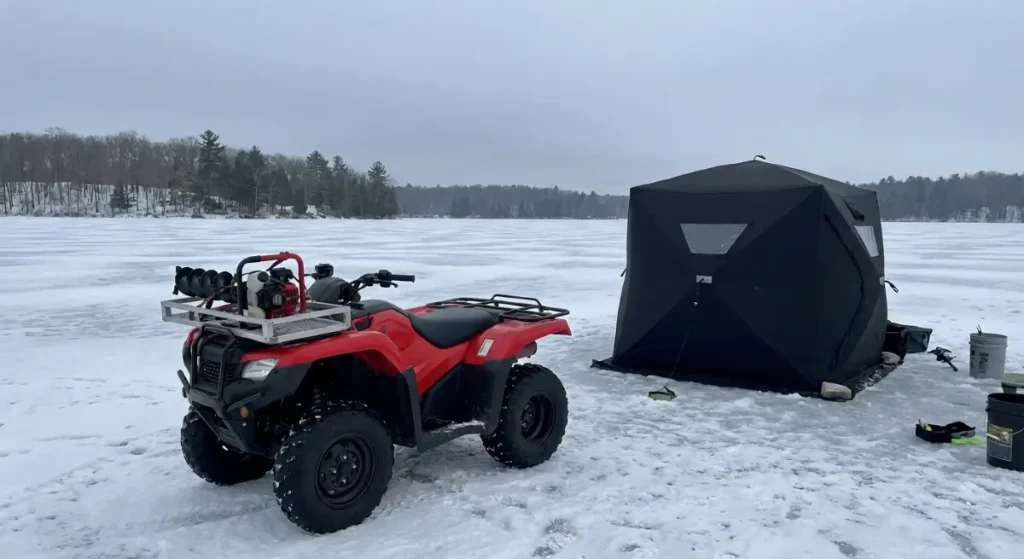
It doesn’t have to be that way. I remember the first time I rolled onto the ice on my Honda Rancher, coffee in the cup holder and a heater strapped to the back rack. It felt like cheating. An ATV isn’t just a way to get to the spot; it transforms into the ultimate mobile tackle box the moment you turn the key.
Are ATVs Good for Fishing? ATVs are incredible fishing tools, specifically for ice fishing and surf fishing where mobility is the biggest barrier to success. They allow you to haul heavy gear (augers, shanties, coolers) over terrain that would stop a truck. However, you must rig them correctly to prevent corrosion from saltwater and suspension sag from heavy towing loads.
The Three Fishing Worlds: How to Setup Your Quad
You cannot just take a stock trail quad, throw a rod on the seat, and expect it to work. The setup for a frozen lake in Ohio is radically different from the setup for a Florida beach run.
The Ice Machine (Hard Water)
In Ohio, my quad spends three months of the year on the hard water. The biggest challenge here is traction and cargo.
- Getting Grip: Rubber tires on glare ice are useless. You have three options.
- Chains: Cheap and effective, but they ride rough on the bare patches of asphalt at the boat ramp.
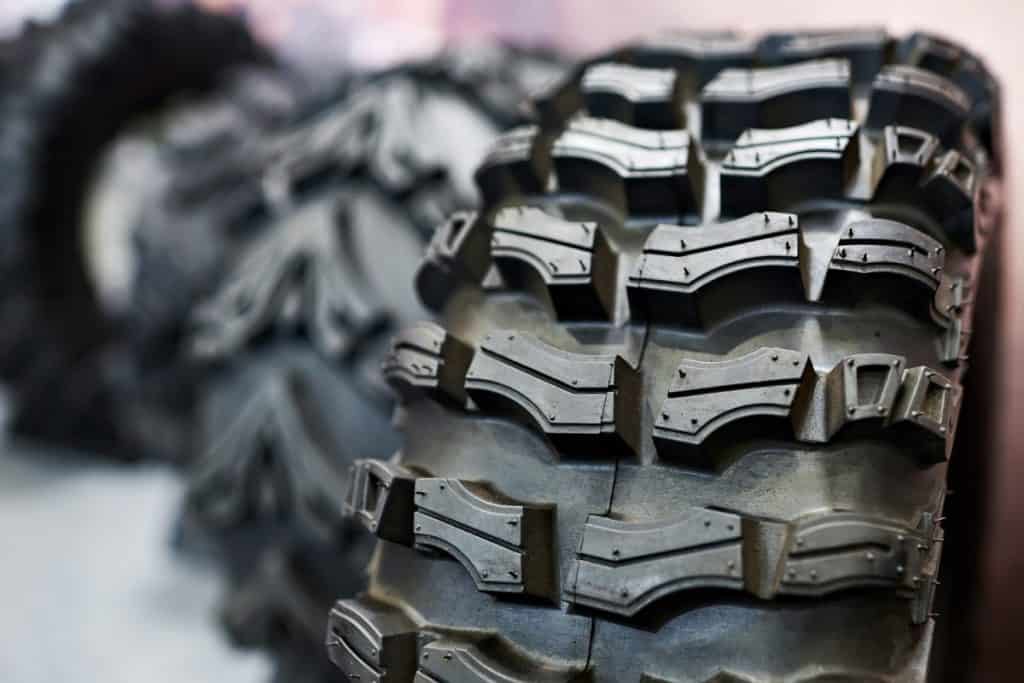
- Ice Studs: These screw into the knobs of your tires. They offer incredible bite without the vibration of chains.
- Tracks: The gold standard for deep snow, but they cost $4,000 and rob horsepower. Unless you are crossing three feet of powder, stick to studs.
- The Auger Problem: An ice auger is a heavy, sharp, awkward piece of machinery. Do not strap it to your back with a bungee cord. I use a “Digger” style auger rack or the “Jaws of Ice” mount on the front rack. It clamps the auger shaft tight so the blades don’t slice your seat—or your leg—when you hit a pressure crack.
- Robert’s Safety Rule: When I ride on the ice, I never buckle my helmet strap. It sounds crazy, but if the ice breaks and you go in, a full-face helmet acts like a sea anchor. It fills with water and pulls your head down. Unstrap it, or better yet, wear a thick beanie and goggles.
The Surf Rig (Salt Water)
Down in Florida, we run the beaches for pompano and shark. The enemy here isn’t the cold; it’s the sand and the salt.
- Airing Down: You see tourists get stuck instantly because they run trail pressure (10-15 PSI). To float on sugar sand, you need to drop your tire pressure to 3-5 PSI. This flattens the tire’s contact patch, allowing it to float rather than dig.
- Warning: If you don’t have beadlock wheels, don’t go below 5 PSI or you will peel the tire right off the rim in a turn.
- Corrosion Control: Saltwater is the silent killer. It conducts electricity better than copper wire. If you ride in the surf, you are effectively turning your wiring harness into a battery terminal.
- The Sprinkler Trick: When I get home from the beach, I don’t just hose the bike off. I hook up a lawn sprinkler, slide it under the frame, and let it run for two hours. It flushes the salt out of the skid plates and A-arms.
The Backcountry Swamp (Remote Lakes)
This is for the bass fishermen trying to reach that “honey hole” pond that doesn’t have a boat ramp.
- Access: I’ve used my winch to lower a jon boat down a steep embankment that a truck could never reach. The ATV acts as a motorized anchor.
- Vermin Control: If you leave your machine parked in the tall grass while you fish for six hours, field mice will find your airbox. I keep a few dryer sheets stuffed under the seat and in the storage box. Rodents hate the smell.
Which Machine Hauls the Heaviest Catch?
Not all quads tow the same. When you hook up a 200-pound flip-over ice shanty, the physics of your suspension changes.
Solid Axle (Honda) vs. IRS (Polaris/Yamaha) for Towing
There is a massive debate between comfort and utility here.
- The IRS Problem: Independent Rear Suspension (found on Polaris Sportsman and Yamaha Grizzly) is designed to be soft. It soaks up bumps. But when you put 100 pounds of tongue weight on the hitch, the rear suspension squats.
- The Result: Your headlights point at the sky. Your front tires lose weight, making the steering dangerously light and vague.
- The SRA Solution: A Solid Rear Axle (like the Honda Rancher 420) doesn’t squat nearly as much because the weight is carried directly by the axle and the swingarm. It stays level.
Robert’s Fix for IRS Machines:
If you fish with a Polaris, you don’t have to sell it. Buy a set of suspension lockout blocks or stiff heavy-duty rear springs. You insert the blocks into the springs before you hook up the shanty. It turns your soft trail suspension into a stiff towing rig for the day.
Rack Capacities & Towing Limits
Here is how the heavyweights stack up when it’s time to drag the shanty.
| Machine | Rear Suspension | Towing Capacity | Rack Capacity (F/R) | Best Fishing Application |
| Honda Rancher 420 | Solid Axle (SRA) | ~848 lbs | 66 / 133 lbs | Ice Fishing: Zero squat with heavy sleds. |
| Polaris Sportsman 570 | Independent (IRS) | ~1,350 lbs | 90 / 180 lbs | Remote Lakes: Smooth ride for fragile gear. |
| Yamaha Grizzly 700 | Independent (IRS) | ~1,322 lbs | 110 / 198 lbs | Surf Fishing: Power to spin tires in deep sand. |
| Can-Am Outlander PRO | Independent (IRS) | ~1,830 lbs | 120 / 240 lbs | The Hauler: Massive capacity for heavy coolers. |
Turning a Quad into a Bass Boat
You can buy fancy gear, or you can build it. I’ve done both.
Rod Transport (Don’t Snap Your Tips)
Transporting fishing rods is terrifying. One low branch, and your $300 St. Croix rod is snapped in half.
- The DIY “Rocket Launcher”: Go to the hardware store. Buy a length of 1.5-inch PVC pipe. Cut it into 18-inch sections. Notch the top to accept the reel foot. Zip-tie or U-bolt these vertically to your milk crate or front brush guard.
- Robert’s Rule: “Tips to the Back.” Never mount your rods angled forward. If you ride through brush, the rod tip will catch a vine and snap instantly. Always angle them backwards so the brush slides off the tip.
- The Pro Option: If you have the budget, the hard-shell cases from Kolpin or Otter are worth it. They completely enclose the rod. I use these for long trail rides where mud and rocks are flying everywhere.
The “Bucket Hugger” System
The 5-gallon bucket is the most important tool in a fisherman’s arsenal. It holds bait, it holds the catch, it holds trash, and it’s a seat.
Most racks are metal bars. Buckets slide off.
- The Fix: You can buy a “Bucket Hugger”—a steel ring that bolts to your rack and drops the bucket into it. Or, use the classic milk crate zip-tied to the rear rack. A standard square milk crate holds a round 5-gallon bucket perfectly snug.
- Sand Spikes: For surf fishing, I mount PVC sand spikes directly to my front bumper. When I hit the beach, I pull the spikes off the bumper, jam them in the sand, and I’m fishing in 30 seconds.
Legal and Environmental Realities
Just because your quad can go there doesn’t mean it’s legal. Fishermen are under a microscope, especially on public land.
Beach Driving Permits
In places like the Outer Banks (OBX) or specific Florida counties, you need a beach driving permit.
- The Dune Line: Never, ever drive on the dunes or the vegetation. That is where the sea turtles nest and what holds the beach together. If a ranger catches you tearing up sea oats, they won’t just fine you; they will confiscate your machine. Stay below the high tide line where the sand is wet and hard-packed.
Noise Etiquette
Sound carries over water. If you ride your loud, aftermarket-exhaust mud bike down to a quiet trout stream, every angler within a mile will hate you.
If you use your ATV for fishing, keep the stock muffler on it. We are there to enjoy nature, not deafen it.
Conclusion
An ATV is the great equalizer. It allows an older guy with bad knees to get to the surf. It lets a father take his kids to the far side of the frozen lake away from the crowds. It opens up water that the guys in the $80,000 bass boats can’t reach and the hikers are too lazy to walk to.
Rig it right, wash the salt off, and respect the terrain. The fish are waiting.
FAQ
Will saltwater ruin my ATV?
It will if you ignore it. Salt causes galvanic corrosion between dissimilar metals (like steel bolts in aluminum engine cases). The secret is Dielectric Grease. Before you hit the beach, unplug your electrical connectors and pack them with grease. After the ride, wash the bike thoroughly with a product like Salt-Away, which neutralizes the salt crystals.
Can I use a winch to pull my ice shanty?
No. Winches are slow and drain the battery. Use a proper drop-hitch receiver on the back of the ATV. If the snow is deep, use a tow strap to extend the distance between the ATV and the sled, which helps prevent the sled from getting blasted by the snow roost from your tires.
How do I keep my bait from freezing on the trail?
If you are ice fishing, put your minnow bucket inside a Styrofoam cooler strapped to the rack. I also wrap the bucket in an old towel. The vibration of the ATV usually keeps the water moving enough to prevent freezing, but the insulation helps on those -10°F days.
Is a 2WD ATV enough for beach fishing?
It’s risky. In hard-packed wet sand, 2WD is fine. But if you have to cross the soft, dry sand near the dunes to get to the water, you will likely get stuck. If you only have a 2WD machine, bring a shovel, recovery boards (traction mats), and air your tires down to 3 PSI.
What is the best ATV for carrying a passenger and fishing gear?
A “2-Up” machine like the Can-Am Outlander MAX or Polaris Sportsman Touring. These have a longer wheelbase and a legal second seat. The longer frame also makes them much more stable when towing heavy loads, reducing the “wheelie” effect when dragging a heavy shanty.