Honda Rancher vs. Rubicon: Which Workhorse Should You Buy?
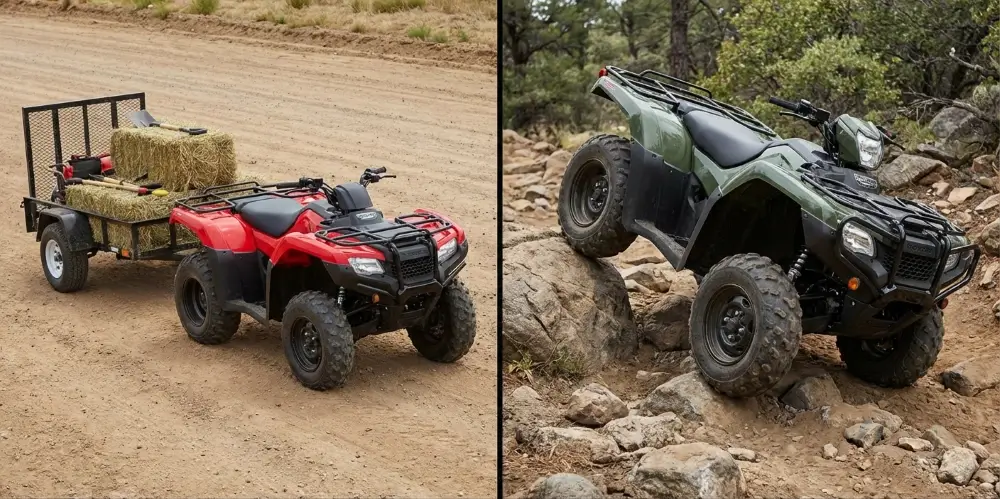
You walk into the dealership, smell the fresh rubber, and see a sea of red plastic. To the untrained eye, the Honda Rancher and the Honda Rubicon look almost identical. They share the same body panels, the same headlight shape, and that legendary Honda reliability. But then you look at the price tag. The Rubicon commands a premium of $2,000 to $3,000 over the base Rancher.
That price gap isn’t just marketing fluff. It represents a fundamental difference in how the machine transfers power to the ground and how it treats your spine after six hours on the trail. Buying the wrong one means either wasting money on features you don’t need or cursing your cheapness when you get high-centered on a stump.
If you need a machine strictly for towing heavy trailers on flat ground or farm work, get the standard Honda Rancher (Solid Rear Axle). It is stable, cheaper, and doesn’t squat under load. If you plan to trail ride, climb technical hills, or plow deep snow, you need the Honda Rubicon. The Rubicon’s Independent Rear Suspension (IRS), Diff-Lock, and Low Range transmission make it a far superior off-road machine.
The Engine and Transmission (The Low Range Dealbreaker)
Most people look at the sticker and see “420cc” vs “518cc” and think that’s the main difference. It’s not. In the real world, the horsepower gap is negligible—we are talking about a difference of maybe 2 or 3 ponies. Both engines use Honda’s Longitudinal Engine Mounting design, meaning the crankshaft runs front-to-back, sending power directly to the driveshafts without a power-robbing 90-degree turn.
The real difference—the one that will make or break your ride—is the transmission gearing.
The Sub-Transmission Secret
The Honda Rubicon comes equipped with a Sub-Transmission featuring a dedicated High and Low Range. The Rancher does not.
The Rancher gets a 5-speed gearbox. That’s it. First gear is low, but it’s not tractor low.
The Rubicon effectively gives you 10 speeds (5 in High, 5 in Low).
I learned this lesson the hard way plowing snow in Ohio. On a Rancher, pushing wet, heavy snow requires you to slip the clutch or ride the torque converter hard because first gear is just a little too tall. On the Rubicon, you drop it into Low Range, and the thing becomes a bulldozer. It pushes without breaking a sweat.
If you plan to run tires larger than 27 inches, you need Low Range. Without it, big mud tires will strain the Rancher’s engine and clutches, making it feel sluggish off the line.
Shift Logic: ESP vs. DCT
Both models offer different shifting flavors, but they behave differently depending on the chassis.
- ESP (Electric Shift Program): You use your thumb to shift up and down. Simple. Reliable.
- DCT (Dual Clutch Transmission): This is Honda’s automatic. It uses real gears and two clutches—one for odd gears, one for even. It shifts faster than you can blink.
- The Nuance: On the Rubicon, the DCT is tuned aggressively for trail riding. On the Rancher, the shift points feel more utilitarian. Robert’s advice? Always learn to use the manual override paddle shifters. The computer doesn’t know you are about to hit a steep incline, but your thumb does.
Suspension and Handling (Solid Axle vs. Independent)
This is where the “feel” of the ride changes completely. You have to decide if you want a machine that works hard or a machine that plays hard.
The Rancher Solid Rear Axle (SRA) Advantage
The base Rancher uses a Swingarm Solid Rear Axle. It’s a steel bar connecting the two rear wheels. When the left tire hits a bump, the right tire tilts.
- Why buy it: Stability under load. If you hook a 1,000-pound trailer to an SRA machine, the rear suspension compresses evenly. The hitch height stays relatively consistent. It doesn’t squat.
- The Ride: It’s rough. On a rocky trail, an SRA machine tosses you side-to-side. You feel every root in your lower back.
The Rubicon Independent Rear Suspension (IRS) Advantage
The Rubicon comes standard with Independent Rear Suspension. Each rear wheel moves on its own A-arms.
- Why buy it: Ground clearance and comfort. The Rubicon boasts 9.7 inches of ground clearance compared to the Rancher’s 7.2 inches.
- Articulation: In a rock garden, one tire can droop down into a hole while the other stays stuffed in the fender, keeping rubber on the ground.
- The Ride: It’s plush. You can ride a Rubicon all day without feeling beaten up. However, if you overload the hitch, the IRS will squat, making the front steering feel light and floaty.
Note: Honda does make a specific trim called the “Rancher 4×4 Automatic DCT IRS EPS.” This is the confusing middle child. It has the Rubicon’s suspension but keeps the smaller engine and lacks the Low Range/Locker.
Off-Road Capability and Traction Tech
You are halfway up a greasy, clay-slicked hill in Wayne National Forest. One front tire lifts off the ground. What happens next depends on which bike you bought.
TraxLok vs. The True Locker
Both machines have Honda’s TraxLok system, which allows you to switch between 2WD and 4WD. But the 4WD systems are not created equal.
- The Rancher (3-Wheel Drive): The Rancher uses a torque-sensing limited-slip front differential. If one front wheel loses traction (lifts in the air), the system tries to transfer power to the other wheel, but it’s not instant. You often have to tap the front brake to trick the diff into locking. In a bad mud hole, you effectively have three wheels spinning.
- The Rubicon (4-Wheel Drive): The Rubicon has a button that says “Diff Lock.” When you push it, a mechanical sleeve slides over the gears and locks both front axles together. It doesn’t matter if one wheel is in the air or buried in mud; both wheels will turn at the exact same speed. This is the “get out of jail free” card.
Down in Florida, we ride deep ruts. I’ve seen Ranchers get high-centered because they couldn’t get that one front tire to bite. The Rubicon pilots just hit the locker button and crawl right out. If you ride technical terrain, the Locker is worth the extra cash alone.
2025 Specs Head-to-Head
Here is the breakdown of the numbers that actually impact your ride.
| Feature | Honda Rancher (Base 4×4) | Honda Rubicon (DCT/EPS) | The “Robert” Take |
| Engine Displacement | 420cc | 518cc | Rubicon has more torque, but top speed is similar (~50mph). |
| Transmission | 5-Speed (No Low Range) | 5-Speed + Low Range | Low Range is critical for 27″+ tires or heavy plowing. |
| Rear Suspension | Solid Axle (SRA) | Independent (IRS) | IRS rides smoother; SRA tows better. |
| Ground Clearance | 7.2 Inches | 9.4 – 9.7 Inches | You will scrape the skid plate often on a Rancher. |
| Front Differential | Limited Slip | Fully Locking | The Locker prevents you from getting stuck in cross-ruts. |
| Seat Comfort | Standard/Firm | Plush/Thick Foam | Rubicon is designed for all-day comfort. |
| Towing Capacity | ~848 lbs | ~1,322 lbs | Rubicon has the brakes and frame to stop the load safely. |
The Ergonomics and Comfort Factor
We talked about the metal; now let’s talk about the contact points. Honda clearly intends the Rancher for short bursts of work and the Rubicon for long days of adventure.
The Seat Test
This sounds minor until you are four hours into a ride. The Rancher seat is flatter and firmer. It’s designed so you can slide off easily to open a gate. The Rubicon seat is thicker, wider, and softer. It cradles you more like a sofa.
Power Steering (EPS)
You can get a Rancher without Power Steering to save money. Don’t.
Unless you are built like a linebacker, wrestling a 600lb quad through tight woods without EPS is exhausting. The Electric Power Steering acts as a steering damper. When you hit a hidden stump, the EPS absorbs the impact so the handlebars don’t rip out of your hands. The Rubicon almost always comes with EPS (except on rare base trims), while it’s an expensive option on the Rancher.
Who Should Buy What?
I’ve steered dozens of people toward these bikes. Here is how the scenarios usually play out.
Scenario A: The Land Owner
You own 40 acres. You need to spray weeds, drag a harrow for a food plot, and check the fence line. You rarely leave your property.
- The Verdict: Buy the Honda Rancher 4×4 (Foot Shift). You don’t need IRS to spray weeds. You don’t need a locker to drag a deer. The SRA suspension will handle the tongue weight of your sprayer tank better than the Rubicon. Save the $2,500.
Scenario B: The Trail Dad
You want to take the family to Hatfield-McCoy or ride the sand trails in Ocala. You might put a passenger seat box on the back (even though the sticker says not to).
- The Verdict: Buy the Honda Rubicon DCT EPS. Your back will thank you for the IRS. The automatic transmission lets you focus on the trail, not the clutch. And when you inevitably slide into a mud hole you underestimated, the Diff Lock will save you the embarrassment of needing a winch.
Scenario C: The Mud Builder
You plan to put a lift kit, snorkel, and 28-inch Assassinator tires on it immediately.
- The Verdict: Buy the Rubicon. You need the Low Range gear reduction to turn those heavy tires. If you put big mud tires on a Rancher, you will be burning up clutches and stalling constantly because the gearing is too tall.
FAQ
Can I put a lift kit on a Rancher to make it as high as a Rubicon?
You can, but it comes with a cost. Because the Rancher uses a solid rear axle, lifting it increases the angle on the U-joint driveshaft. This leads to vibration and premature U-joint failure. The Rubicon’s IRS geometry handles lift kits much better because the CV axles have more range of motion.
Is the 518cc engine in the Rubicon much faster?
Not really. Both machines top out around 48-52 MPH depending on the tires. The 518cc has more grunt (torque) at the bottom end, which helps turn the heavier chassis, but in a drag race, they are surprisingly close.
Why does my Rancher DCT shift clunky?
Honda’s DCT is a mechanical transmission that is shifted by an electric motor. It can feel “jerky” at low speeds compared to a belt-driven CVT (like a Polaris). This is normal. It gets smoother as you break it in, but it will always have a distinct “click-clunk” feel. It’s the sound of durability.
Can I add a Locker to a Rancher later?
Technically, yes, aftermarket lockers exist (like Torq-Masters), but they are expensive and difficult to install. By the time you buy a Rancher, add a lift, add a locker, and upgrade the tires, you have spent more than the cost of a Rubicon and voided your warranty. Just buy the Rubicon up front.
Which one is better for snow plowing?
The Rubicon wins, hands down. The combination of Low Range (to push heavy snow without straining the engine) and the Diff Lock (to maintain traction on ice) makes it a superior plow rig. The Rancher can do it, but you will find yourself spinning tires and slipping the clutch in heavy wet snow.