Will Car Tires Fit ATV Rims? (The Pros, Cons, and Safety Risks)
You’re scrolling through a tire website, and you see the price tag for a set of premium ATV mud tires. Four hundred dollars. Maybe five. Then you look at a set of all-terrain light truck tires for a Geo Tracker or a small pickup, and they are half the price and rated for 40,000 miles.
The gears in your head start turning. You want the “Forever Tire”—rubber that never wears out, never punctures, and lets you ride down the road legally. It sounds like the perfect hack. But putting steel-belted automotive rubber on a lightweight aluminum ATV rim isn’t just a matter of matching the diameter. It’s a physics problem that breaks axles, burns belts, and, if you aren’t careful, explodes in your face.
Will Car Tires Fit ATV Rims? Yes, automotive tires will fit your ATV rims, provided you have 14-inch or 15-inch wheels. You cannot fit car tires on standard 12-inch ATV rims because no automotive manufacturer makes off-road tires that small anymore. However, fitting them comes with a massive weight penalty, difficult bead seating, and a complete loss of traction in deep sand or mud.
12-inch vs. 14-inch vs. 15-inch Rims
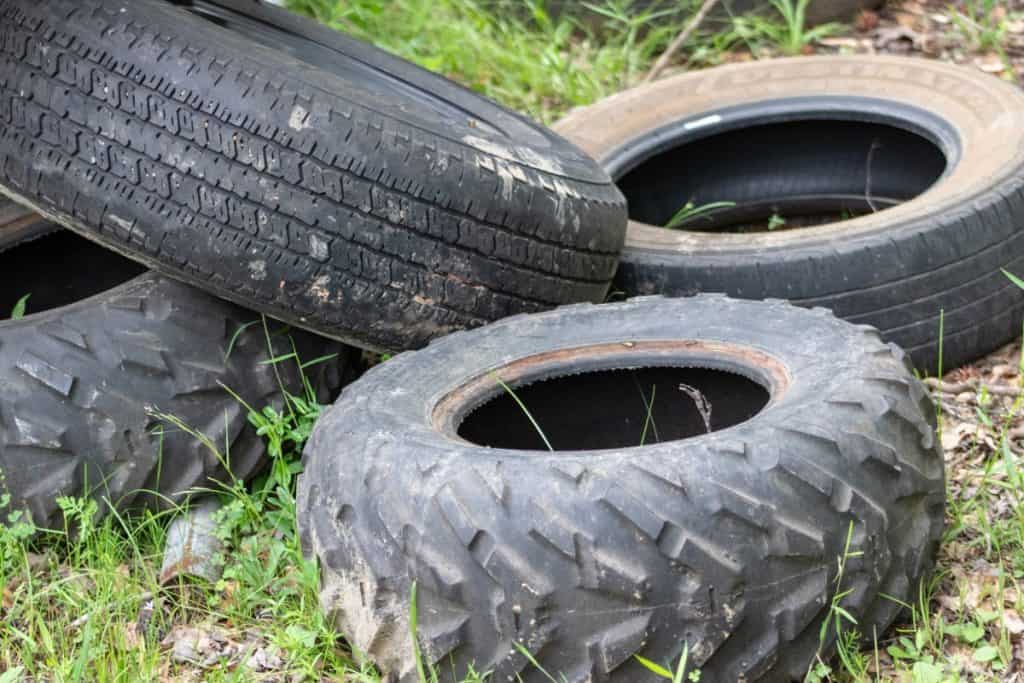
Before you head to the salvage yard, you need to look at the stamped number on your rims. The automotive industry and the powersports industry only overlap in a specific window.
The 12-Inch Dead End
If you are riding a stock Honda Rancher, Yamaha Grizzly, or older Suzuki KingQuad, you likely have 12-inch rims.
Stop right now.
You will not find a car tire that fits. The smallest common automotive rim size in the last 20 years is 13 or 14 inches. You might find ancient 12-inch tires from a 1980s hatchback, but they are street slicks. They have zero off-road capability. To run car tires, you must upgrade to aftermarket 14-inch or 15-inch ATV rims.
The 14-Inch and 15-Inch “Sweet Spot”
This is where the magic happens. Many modern UTVs (and upgraded ATVs) run 14-inch rims. This size matches the smallest Light Truck (LT) tires available.
- The Golden Size: The most popular crossover size is 27×8.5R14.
- The Tire: The General Grabber A/T X or the BFGoodrich All-Terrain T/A KO2 are the go-to choices. They are narrow enough to fit in the wheel wells but tall enough to provide ground clearance.
The Rim Width Warning
Here is the catch. Rear ATV rims are wide—usually 8 to 10 inches. Most 27-inch automotive tires are designed for a 6 or 7-inch wide rim.
If you stretch a narrow car tire onto a wide ATV rear rim, you expose the sidewall. The bead struggles to seal. You look like those “stance” cars with stretched tires. It’s dangerous off-road because a rock can easily de-bead the tire when you corner hard.
Why It’s Not a Simple Swap
Just because the rubber fits on the metal doesn’t mean they want to work together. The geometry is fighting you.
The Bead Seating Danger
This is the part that scares me.
ATV rims have a specific bead seat angle and a very thin rolled lip designed for soft, flexible tires. Automotive tires have a thick, stiff, steel-reinforced bead designed for steel car rims.
Getting that thick car tire bead to “pop” over the safety hump of an ATV rim is a nightmare.
I once watched a buddy try to seat a truck tire on a Polaris rim in his garage. He kept adding air. 40 PSI. 50 PSI. The tire wouldn’t seat. At 65 PSI, the tire didn’t blow—the rim failed. The aluminum lip sheared off and shot across the shop like a piece of shrapnel. It missed him by inches. If you do this, use a tire cage or take it to a professional shop. Do not stand over it.
Unsprung Weight and Rotational Mass
An ATV is designed to spin light, 4-ply balloon tires. When you bolt on a steel-belted truck tire, you are adding massive mass.
- The Physics: Adding 1 lb of rotating weight (tires) is roughly equivalent to adding 7 lbs of static weight (cargo) in terms of acceleration loss.
- The Damage: This extra mass wreaks havoc on your driveline. Stock CV axles are the first to snap. The joints aren’t built to turn that kind of momentum. If you stick a heavy car tire in a bind between two rocks, the tire won’t give. The axle will.
Where Car Tires Fail
I have ridden setups like this. The experience varies wildly depending on where you put the tires.
Sand and Mud (The “Diggers”)
In Florida, car tires are useless.
ATV tires work by “ballooning.” When you lower the pressure, the footprint expands, allowing you to float on top of the sand. Car tires have stiff sidewalls. They don’t balloon. They cut.
In sugar sand, a car tire acts like a pizza cutter. It digs straight down until you are frame-deep.
In Ohio clay, it’s a different problem. Automotive All-Terrain treads are tight. They are designed for quiet highway driving, not self-cleaning. One rotation in sticky clay, and the tread fills up. You effectively have racing slicks. You will be spinning and sliding while your buddies on Maxxis Zillas walk right past you.
Hard Pack and Rocks (The “Iron Sides”)
This is the only scenario where car tires win.
If you ride fire roads, gravel pits, or sharp shale rock (like in parts of Pennsylvania or Arizona), car tires are invincible.
A standard ATV tire has a soft carcass. A sharp piece of shale slices it like butter. A Light Truck (LT) tire has steel belts and 8-ply or 10-ply ratings. You can run over cactus, glass, and jagged rocks all day. They simply do not puncture.
ATV Rubber vs. Light Truck (LT) Rubber
Let’s look at the numbers. I’m comparing a standard aftermarket ATV tire against a popular Light Truck tire of the same size.
| Feature | ATV Tire (Maxxis Bighorn 2.0) | Car Tire (General Grabber A/T X) | The Reality |
| Size | 27×9-14 | 27×8.5R14 | Car tire is slightly narrower. |
| Weight | ~21.8 lbs | ~29 lbs | +7.2 lbs per corner (Huge rotational penalty). |
| Tread Depth | ~0.75 – 1.0 inch | ~0.50 inch | ATV tire has 2x the bite depth. |
| Side Lugs | Aggressive | Non-existent | Car tires offer zero side-bite in ruts. |
| Mileage | ~2,000 miles | ~40,000 miles | Car tires last almost forever on a quad. |
| Cost | ~$180 – $220 | ~$130 – $150 | Car tires are significantly cheaper. |
| Ride Quality | Soft / Flexible | Stiff / Harsh | You will feel every pebble with car tires. |
Necessary Modifications (Don’t Skip These)
If you are determined to do this—maybe you run a security patrol on pavement or ride mostly gravel—you cannot just bolt them on and go.
1. Clutch Kits (CVT Tuning)
If you have a belt-driven ATV (Polaris, Can-Am, Yamaha Kodiak), you must re-clutch.
The extra rotating mass acts like a higher gear ratio. It puts immense strain on the belt during takeoff. You will smell burning rubber within the first mile.
You need a clutch kit with heavier flyweights and a stiffer secondary spring to increase the “belt squeeze” and raise the engagement RPM. This gets the engine into its powerband before the clutch engages, helping to move that heavy steel rubber.
2. Wheel Spacers
Automotive tires often have a squarer profile than round ATV tires. The shoulder of the tire is blocky. On many machines (like the Polaris Sportsman), this square shoulder will rub against the tie rod ends or the strut tower.
You will likely need 1-inch or 1.5-inch wheel spacers to push the tire out away from the suspension components.
3. Suspension Tuning
Because the sidewall of a car tire is so stiff, it provides zero shock absorption. All that vibration transfers to the chassis. You will need to soften your suspension compression settings (if adjustable) to keep your teeth from rattling out on washboard roads.
Conclusion
Putting car tires on an ATV is a trade-off, not an upgrade. You are trading traction, acceleration, and ride quality for longevity and puncture resistance.
If you are a rancher checking fences on gravel roads, or you live in a state where you ride on pavement to get to the trail, it makes sense. The tires will outlast the machine.
But if you are a trail rider—if you hit mud, sand, or technical hill climbs—do not do it. You will turn your capable off-road machine into a heavy, sliding brick that snaps axles and gets stuck in puddles. Stick to specialized ATV rubber. It costs more for a reason.
FAQ
What air pressure should I run in car tires on an ATV?
Do not run the 35 PSI listed on the sidewall! An ATV weighs 700 lbs, not 3,000 lbs. If you run 35 PSI, the ride will be brutal and you will have zero traction.
Drop the pressure to 8 to 12 PSI. Because the sidewalls are so stiff, the tire will hold the weight of the ATV easily even at single-digit pressures.
Are car tires DOT legal on an ATV?
The tires are DOT legal, yes. But that doesn’t automatically make your ATV street legal. Street legality depends on your state’s laws regarding lights, mirrors, horns, and license plates. The tires are just one piece of the puzzle.
Can I use Beadlock rims with car tires?
Yes, and you probably should to prevent de-beading at low pressures. However, you might need a beadlock ring spacer. The bead bundle on a car tire is much thicker than an ATV tire. If you try to tighten the beadlock ring without a spacer, you might snap the bolts or warp the ring before it clamps down tight.
Will these tires ruin my speedometer?
If you stick to a 27-inch car tire and your stock tires were 25-inch, yes, your speedometer will read slow. You will be going faster than the gauge says. This also effectively gears up your machine (making it faster on top end, weaker on bottom end), which is another reason why clutch kits are essential.
Why can’t I plug a car tire on the trail?
You can, but it’s a fight. ATV tires are soft; you can jam a gummy plug in easily. Car tires have steel belts under the tread. Pushing a reamer tool and a plug through steel mesh requires serious arm strength. Bring a heavy-duty T-handle plug kit, not the cheap plastic ones. The plastic handles will snap when you try to force them through the steel belts.